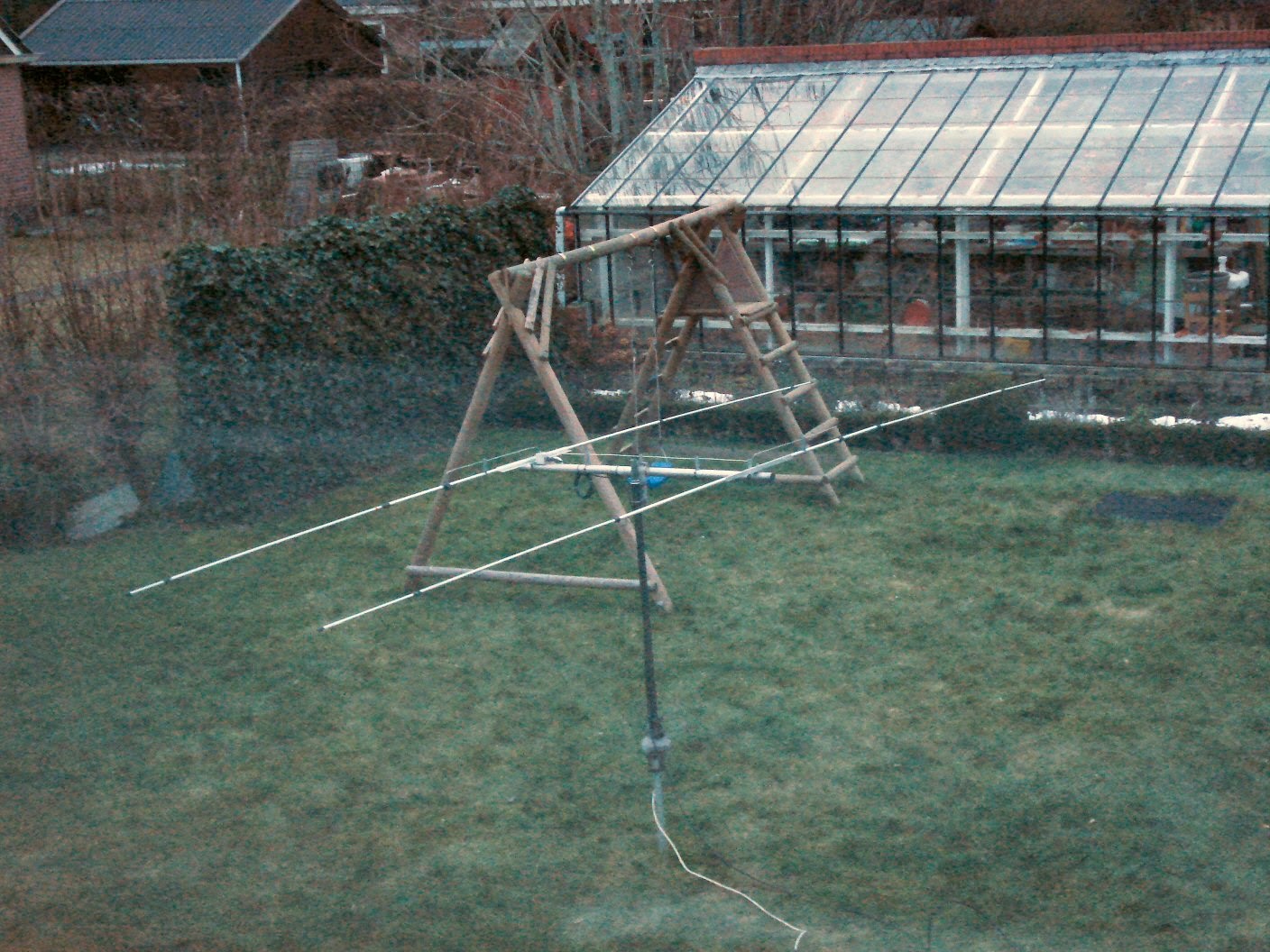
Lot's can be written about the HB9CV antenna and it's construction. But I like to write about how it is working on air and the experiences I encoutered with it and not only about construction as it can be done in many ways. All details can be found on the internet these days.
Anyway, I have to tell the whole story so a little theory is necessary since you will always encounter some minor problems. I don't know were I got the calculating formulas from in the past but it wasn't from Rothammel's antennabook which I posess. I didn't really know but I always used the 75 Ohm formula as long before the internet I didn't have anything else. But now it seems there is a slight difference between the 75 Ohm and 50 Ohm version. Never noticed a bad SWR or so, but didn't have a analyser as well at that time. So, there are 3 different basic models as you can see in the picture. The difference between the 75 and 50 Ohm version is the gamma match.
 I use the 50 Ohm formula for my HB9CV this time. Besides that I used a piece of cheap 75 Ohm coax as capacitor. I don't write about the exact building as there are many sites on the internet about that.
One of the best sites I found regarding the HB9CV, you need to translate however. Should be no problem: http://www.ok2kkw.com/hb9cv/hb9cv_1969.htm. Unfortenately you won't find that the actual design is for a 75 Ohm coax cable.
All this HB9CV writing, thinking and building made me remember some personal notes. Sometimes you almost forget things that happened in the past. I encountered happy and sorrow times with the HB9CV antenna back in the early nineties of last century. The first HB9CV was made for a friend that had a very bad traffic accident. He was in a wheelchair and most of his radio and antennawork was done by friends. Unfortenately when I finished the antenna his health went very bad. He couldn't barely talk anymore. He persisted to put the antenna on the mast myself. A year later he died. Second one was built for another friend which I contacted lately via facebook. I remember this HB9CV as the one that was struck by lightning and still survived. I only had to go up to his roof and replace the capacitor and box + coax. The lightning did get from the coaxcable into a copper gastube made a hole and he had a fire upstairs since gas was flowing out. Luckely he was at home and could turn off the gas. He recently wrote me he sell his HB9CV as he had no place for it at a new home. The third one was made as a birthday gift ordered by a XYL from one of my radiofriends at that time. He had a incurable brain tumor and all he wanted was a HB9CV. I made him one and helped to raise the antenna at his birthday. I remember he was very very happy and I made many QSO's with him always with both HB9CV's pointed to each other. Besides that he was finally able to do some decent DX. He passed away about a year later leaving his wife and 2 kids. I measured the antenna for him when constructing and you can see the results in the "plot". But there were also happy times. We had a lot of DX fun of course with our HB9CVs. A lot of DX with 25W all over the world. I worked at least 220 DXCC with this antenna on the 11m band and it never let me down.
Curious how the "new" HB9CV is going to work?
Er kan veel geschreven worden over de HB9CV antenne en de constructie ervan. Maar ik wil meer vertellen over hoe zo een antenne in de praktijk werkt en de ervaringen en verhalen er om heen omdat de HB9CV op diverse manieren gemaakt kan worden. Tegenwoordig kun je er van alles over vinden op internet.
Maar goed een klein beetje theorie ontkom je niet aan omdat je toch altijd weer wat probleempjes tegenkomt tijdens het bouwen. Ik weet niet meer waar ik destijds de formule's vandaan had om de antenne te berekenen maar het was volgens mij niet uit het
antenneboek van Rothammel die ik bezit. Ik wist het eigenlijk niet maar ik werkte altijd met de 75 Ohm formule omdat ik lang voor internet gewoon niet anders had. Nu blijkt dat er een klein verschil zit in de lengte van de gammamatch voor 75 Ohm en 50 Ohm. Eigenlijk is het me nooit opgevallen, geen echt slechte SWR of zo, maar goed ik had ook geen antenne analyzer destijds. Zoals te zien op het plaatje zijn er zelfs 3 versies.
Voor mijn HB9CV gebruik ik dus de 50 Ohm formule dit keer. Daarnaast gebruik ik geen variabele C maar een stuk goedkope 75 Ohm coax als condensator. Ik ga niet schrijven over hoe ik dingen gemaakt heb want er is al genoeg over te vinden op internet.
Een site die volgens mij de beste omschrijving geeft van de HB9CV antenne is helaas in het Tjechisch. Maar vertalen hoeft vandaag de dag geen probleem op te leveren. Kijk maar eens hier:
http://www.ok2kkw.com/hb9cv/hb9cv_1969.htm. Helaas vind je daar niet dat het oorspronkelijke design voor een 75 Ohm coax bedoeld is.
 |
| Parts so far... |
Al dat geschrijf, denken en bouwen van de HB9CV antenne brengt ook weer herinneringen naar boven. Sommige dingen was ik haast al vergeten. Daarom is het leuk ze hier weer eens op te schrijven. Minder leuke maar ook goede ervaringen met de HB9CV heb ik gehad begin jaren 90 van de vorige eeuw. De eerste HB9CV die ik maakte was voor een radio vriend die een ernstig auto ongeluk maar net had overleeft. Hij zat in een rolstoel en alles moest voor hem gemaakt en gedaan worden. Voor hem maakte ik een HB9CV van een oude beam van hemzelf. Toen ik de antenne af had werd hij helaas heel erg ziek en wel zo erg dat hij ook niet meer voor de radio kon praten. Hij stond er op dat ik de antenne zelf in de mast zou maken. Een jaar later overleed hij. De tweede HB9CV maakte ik voor een andere vriend en herinner ik me altijd als de antenne die de bliksem overleefde. Ik hoefde destijds alleen het dak op om de condensator + kastje en de coax te vervangen. Erger was dat de bliksem van de coax in de koperen gasbuis was gesprongen en daar een gat in had gemaakt, brand dus op de zolder! Gelukkig waren ze thuis en kon de gaskraan snel dicht gedraaid worden. Ik heb deze amateur laatst weer via facebook ontmoet en hij vertelde dat hij de antenne net had verkocht omdat hij er geen plaats meer voor had op het nieuwe huis. De derde HB9CV maakt ik in opdracht van een XYL die het als cadeau aan haar man wou geven. Deze radiovriend had een hersentumor die niet meer te genezen was en waarschijnlijk was dit zijn laatste verjaardag, het enige wat hij wou was een HB9CV. Ik heb het ding op zijn verjaardag samen met hem in de mast gezet en hij heeft er veel plezier van gehad. We hebben diverse QSO's gehad met de HB9CV's naar elkaar toe met mooie signalen en hij was eindelijk in staat echte DX te doen. Helaas overleed hij ongeveer een jaar later en liet hij zijn vrouw en 2 kinderen achter. Ik heb destijds de antenne voor hem nagemeten en het stralingsdiagram is dus te zien in het plaatje. Maar er waren natuurlijk ook leuke tijden, we hebben veel DX gedaan met de HB9CV's. Gewoon met 25W de hele wereld rond. Op 11m heb ik met deze antenne zeker zo een 220 DXCC gewerkt en het ding heeft me eigenlijk nooit in de steek gelaten.
Ben benieuwd hoe de "nieuwe" HB9CV gaat werken?